
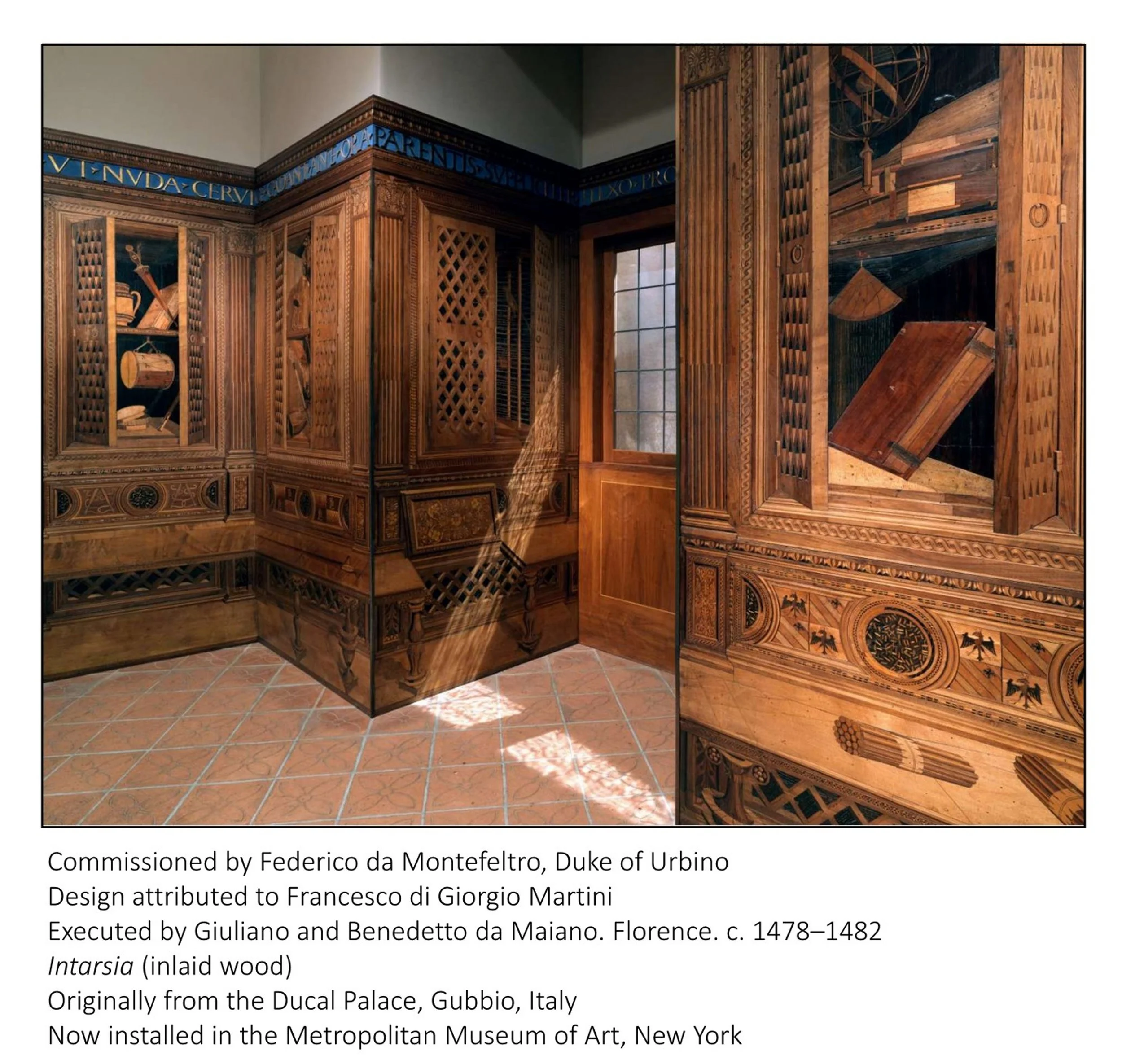
The Gubbio Studiolo
Continued from Ryan Art & Design Instagram series
(Scroll to end for an image and some information about Federico da Montefeltro)
The Gubbio Studiolo, created in c. 1480 for Federico da Montefeltro, Duke of Urbino, is one of the most remarkable interiors of the Renaissance. More than a private study, it was a statement of identity.
During this period, the ideal of the cultivated “Renaissance man” emerged. Inspired by the values of Classical Antiquity, the “Humanist” sought knowledge across many fields, and the studiolo became both a place for intellectual pursuits and a symbol of them.
The extraordinary wood inlay (intarsia) covering the doors of the actual cabinets, depicts trompe l’oeil (fool the eye) cabinets and shelves filled with objects expressing Humanist values and interests: Latin and Greek manuscripts, musical instruments, tools for exploring mathematics, the heavens and the earth, antiquities, and other rare collectable – many of which were stored -- it was to be assumed --in the actual cabinets behind the doors. Together, they expressed an interest in learning, curiosity, discovery, and the revival of Classical Antiquity that all Renaissance men wanted to be seen as valuing.
However, the most powerful symbol by far is the illusionistic imagery, the product of a cutting edge technological development that, for the first time, allowed artists to create convincing depictions of three-dimensional space on a flat surface. Famously demonstrated by Filippo Brunelleschi in Florence, c. 1420, linear perspective represented a revolutionary way of understanding and depicting reality. Appearing at precisely the moment when Europeans were beginning to see, understand, and represent the world in fundamentally new ways, its emergence was no coincidence. The room itself was —and remains — a testament to the new level of of observation, intellectual curiosity, and artistic skill so characteristic of the Renaissance.
Using this new system, the Florentine master craftsmen of intarsia, the brothers Giuliano and Benedetto da Maiano, transformed the cabinet doors into convincing representations of cupboards, shelves, and the treasured possessions the actual doors concealed. But nothing behind those doors could bestow the mantle of Humanist upon the owner more fully than his awareness and understanding of this breakthrough.
For that reason, the Gubbio Studiolo stands not only as a masterpiece of Renaissance design, but as one of history's greatest demonstrations of the ability of interiors to communicate ideas. Few spaces so completely unite form and meaning.
It also reminds us that the greatest interiors were never simply beautiful rooms. They gave physical form to ideas, values, beliefs, and ways of understanding the world. Every surface, every object, every material contributed to a larger vision —meaning made visible.
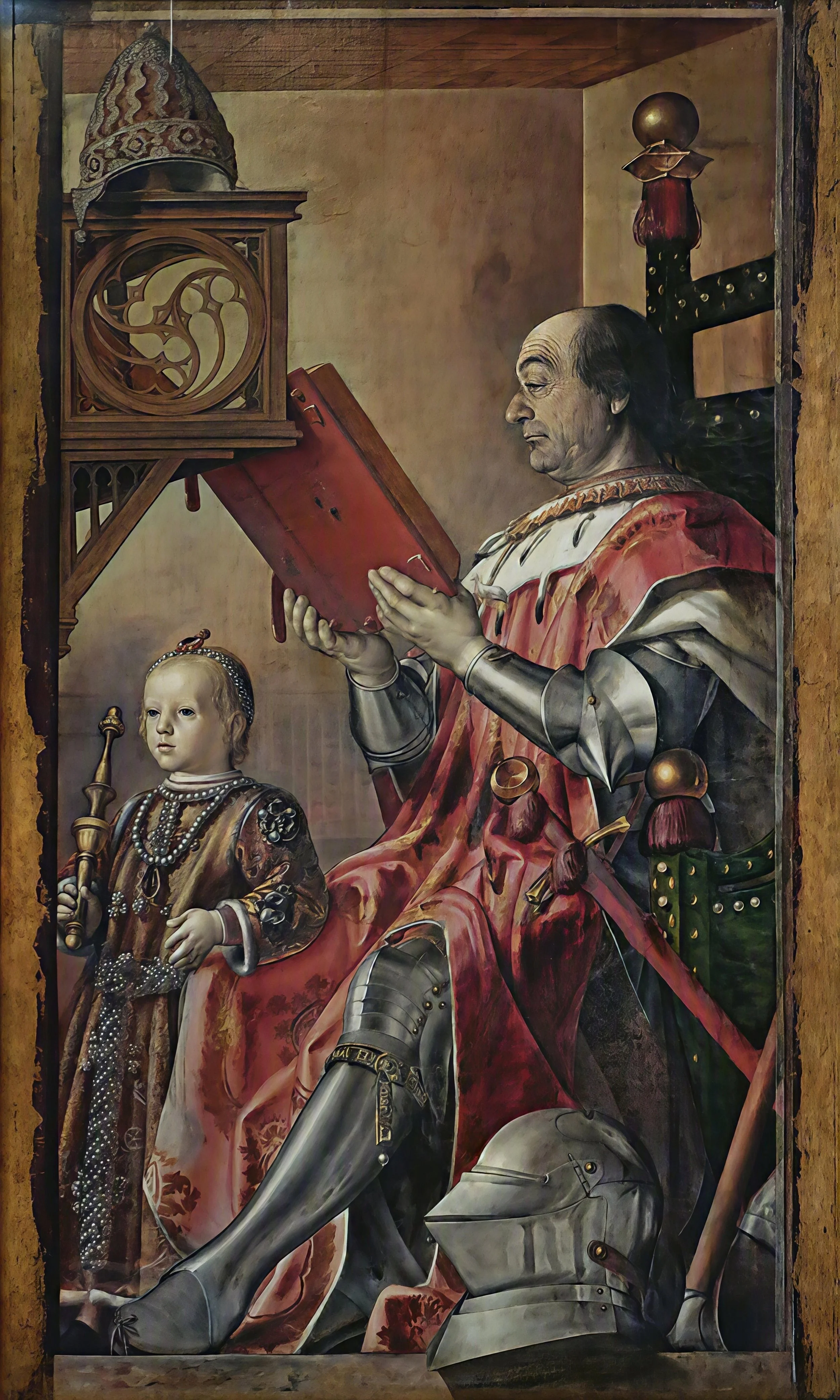
Portrait of Federico da Montifeltro, Duke of Urbino with this son, Guidobaldo da Montifeltro by Pedro Berruguete. c. 1480
The famous Duke was a successful condottiero — general of a mercenary army — held in high regard by many, especially various Popes, who frequently used his services. But he was also an ardent and proud Humanist. And if his studiolos (Plural. Yes. He had two such studiolos) weren’t enough to convince people of this, he also had himself depicted here, as he wanted to be seen and known, as the great military leader he was, but also reading a book, presumably of philosophy from Classical Antiquity or the like.