
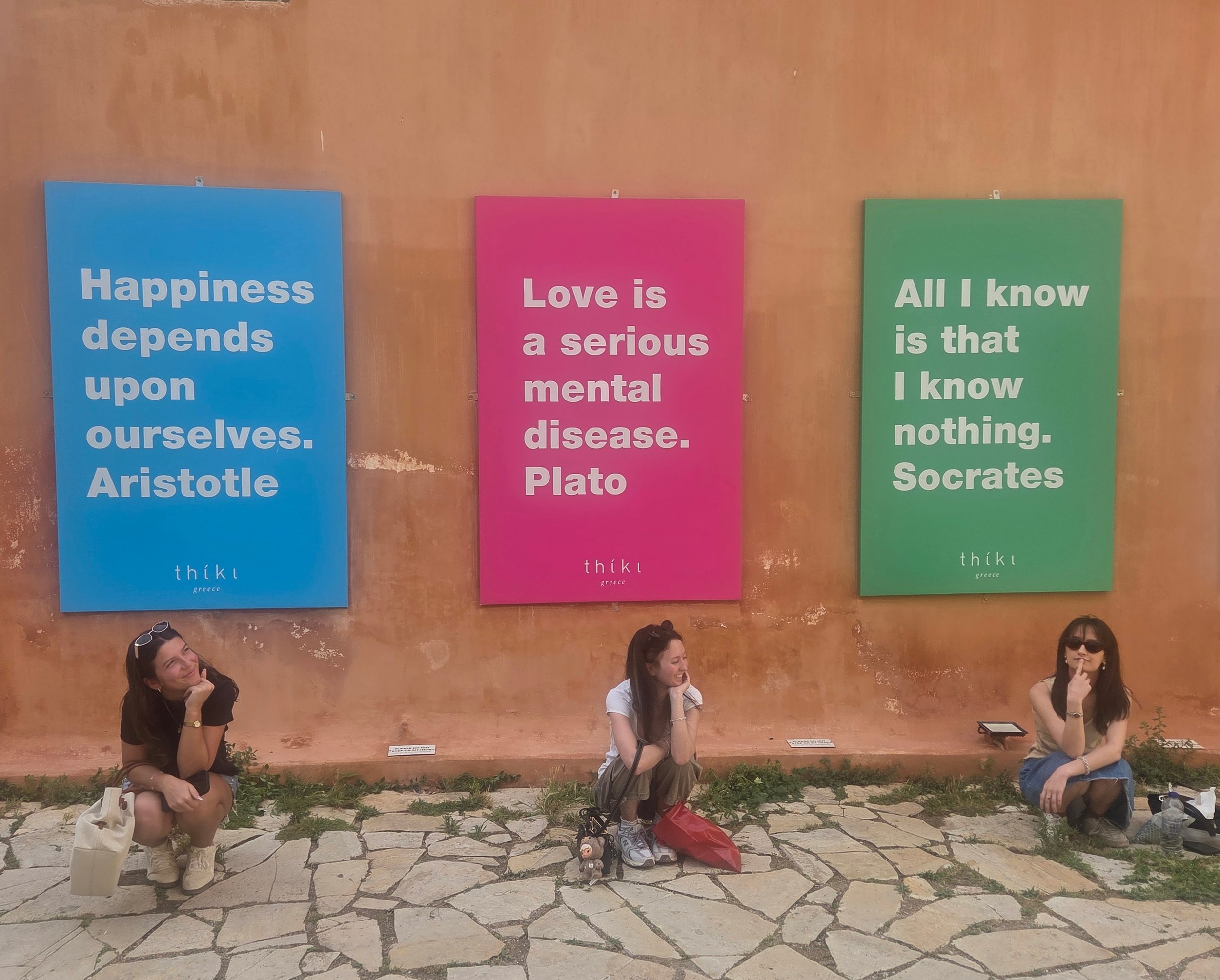
Three of the author’s students in Athens, Spring 2026
In Part I of Finding Your Voice as a Designer, we introduced the idea of creative voice: the distinctive way a designer sees, interprets, judges, and expresses ideas through design.
In Part II, we explored how to discover and develop that voice—through observation, experimentation, reflection, and the gradual recognition of patterns in our creative thinking.
But what lies beneath those patterns? Why do certain things appeal to us while others leave us indifferent? Why do we make the choices we do? And why does a finished design sometimes produce that unmistakable feeling of recognition: This is me.
The answers lead us to something fundamental: our personal design philosophy.
Our creative voice does not develop independently of what we believe. It grows out of our values, experiences, convictions, and ideas about what design should accomplish.
Design philosophy is the foundation. Creative voice is its manifestation.
Understanding that relationship can help us achieve something more important than a recognizable style. It can help us produce work that is more intentional, more coherent, and ultimately more meaningful—work that is personally satisfying because it expresses something we value deeply, and that may have a more powerful impact on others because of the conviction and coherence underlying its design.
What is a Personal Design Philosophy?

Dreamstime 16019070 Michaela Stejskalova
A design philosophy is the collection of beliefs, values, and principles that informs the way we approach design.T hese beliefs may concern what makes a design successful, how materials should be used, the relationship between beauty and function, or the responsibilities a designer has toward the people who inhabit a space. They may also concern the creative process itself.
One designer may believe that successful design depends upon simplicity and visual clarity. Another may believe that richness and complexity are essential to creating compelling environments. One may believe that materials should express their inherent qualities. Another may place particular importance on the imaginative transformation of materials. A designer may believe that careful planning is the foundation of successful work, while also believing that experimentation, improvisation, and unexpected discoveries are indispensable to the creative process.
These are not necessarily mutually exclusive positions. A personal philosophy may embrace principles that initially appear contradictory. Nor must a philosophy be expressed in a formal statement. Many designers work from deeply held beliefs they have never consciously articulated. Nevertheless, those beliefs influence their decisions. They affect what the designer notices, what they value, what they reject, and what they ultimately choose to do.
A design philosophy is not a style. It is not a collection of preferences or a statement constructed to impress potential clients. It is something more fundamental: what we believe about design, and why we believe it.
The Foundation and It’s Expression

Dreamstime 28336157 @Ivelinr
Creative voice and design philosophy are not two separate aspects of a designer's creative identity. They are intimately connected—two sides of the same coin Our philosophy provides the underlying beliefs and principles. Our creative voice is the way those beliefs find expression through our particular ways of seeing, interpreting, judging, and making.
Consider two designers who share the belief that an interior should reflect the individuality of its inhabitants.
One may also believe that richness, variety, and unexpected relationships express the complexity of human experience. Their creative voice might be characterized by layered compositions, unusual combinations, and an appreciation for irregularity. The other may believe that clarity, restraint, and order contribute to well-being. Their creative voice might favor carefully selected objects, simplicity, and a strong sense of visual organization.
Both designers value individuality, but their other beliefs influence how that shared principle finds expression.
Conversely, two designers may produce work that looks remarkably similar while approaching it from different philosophical positions. One may favor simplicity because they believe that materials should be allowed to express their inherent character without unnecessary embellishment. Another may pursue simplicity primarily because they value the expressive power of proportion, geometry, and carefully controlled relationships.
In either case, appearance alone cannot tell us everything about the beliefs that shaped the design. A philosophy does not dictate a particular appearance; it informs the thinking behind it. And that thinking is not always conscious. We may develop convictions long before we recognize them as such.
In Part II, we examined our attractions, objections, recurring choices, and creative tendencies as a way of discovering our voice. But in doing so, we were also gathering evidence of the beliefs underlying that voice. Through self-examination, we begin to recognize those beliefs. Once we become conscious of them, we can question them, develop them, and use them more deliberately.
The philosophy informs the voice. Examining the voice helps us understand the philosophy. And both continue to develop through the experience of designing.
Why Does Understanding Your Philosophy Matter?

Dreamstime n96559937 © Chih Yuan Wu
We don't develop a philosophy simply by deciding what looks good or what works. Our beliefs grow out of the experiences, values, and ideas that have affected us deeply enough to shape how we think. Over time, they contribute to our understanding of what matters.
Our beliefs are connected to what we find meaningful.
When those beliefs find expression through our creative voice, our work becomes more meaningful to us because it expresses something we value deeply. A design may be beautiful, functional, and technically accomplished. It may satisfy every practical requirement and employ the Elements and Principles of Design with considerable skill. But when its decisions also arise from deeply considered beliefs, the work can possess another dimension: a sense of purpose and conviction that extends beyond its individual parts.
The client may not know the designer's philosophy. They may never hear it explained or recognize the principles that informed the decisions. But they can experience the result.
The choices are not isolated. They are related through an underlying way of thinking that influences what is emphasized, what is restrained, what belongs, what does not, and how everything comes together. A philosophy can provide a sense of coherence even when the individual elements are quite different.
Of course, conviction alone does not guarantee successful design. Beliefs must be translated into form through knowledge, skill, imagination, and judgment. But when that translation succeeds, the result can have an impact that goes beyond technical competence or visual appeal.
In Part II, we discussed the distinction between resolution and recognition: Resolution tells you the design works. Recognition tells you it is yours.
Now we can begin to understand why that recognition occurs. The work feels like ours because, in some essential way, it embodies things we believe in. This does not mean that a designer should impose personal preferences on a client. An interior must serve the people who inhabit it, not simply express the identity of the person who designed it. But a designer brings something of themselves to every project: a way of seeing, an understanding of relationships, a set of values, and a particular approach to solving problems. The work belongs to the client, but the creative thinking that gives it form is unmistakably the designer's.
Understanding what you believe—and why you believe it—allows you to bring more of what matters to you into your work.
It also gives you a stronger foundation for deciding what that work should become.
Philosophy as a Basis for Design Judgement

Dreamstime 317033189 © BiancoBlue
Design requires countless decisions. Some are practical. Will a material withstand daily use? Does the space meet accessibility requirements? Can the proposed solution be achieved within the budget?
Others are aesthetic and conceptual. Does the composition express the intended design concept? Is a particular contrast too strong? Would greater simplicity strengthen the design—or diminish something essential?
Technical knowledge helps us address many of these questions. The Elements and Principles of Design provide tools for organizing and evaluating visual relationships. But they do not tell every designer what matters most.
Two equally knowledgeable designers can approach the same problem, employ the same principles, and arrive at very different solutions. Their philosophies help establish their priorities. And this becomes particularly valuable when something doesn't feel right.
We have all experienced that moment when something just doesn't seem right, but we cannot immediately explain why. Rather than simply dismissing the result, we can examine it in relation to our underlying principles. Perhaps the composition is technically balanced, but the symmetry feels too predictable because we value surprise and irregularity. Perhaps a room is beautifully coordinated, but we find it unsatisfying because we believe interiors should express individuality rather than stylistic uniformity. Or perhaps a material is visually appropriate, yet something about its use troubles us because we believe materials should be treated with a certain degree of honesty.
Our philosophy can help us identify what lies beneath an instinctive reaction. It gives us a way to move from I don't think this works toward a more precise understanding of why. That understanding can improve our judgment. It also allows us to distinguish between a habitual preference and a principle we genuinely want to uphold.
A design philosophy should not replace instinct. It should help us understand and develop it.
Discovering the Beliefs Beneath Your Voice

Dreamstime 47173129 © Mimagephotography
In Part II, we considered how our attractions, objections, recurring choices, and responses to our own work can reveal patterns in our creative thinking. Those discoveries provide the starting point for understanding our philosophy. But now the question changes.
Instead of asking only, What am I responding to? we begin asking, What does that response suggest about what I believe?
Perhaps you repeatedly admire interiors incorporating aged surfaces, imperfect objects, and evidence of earlier lives. At first, you might describe this as a preference for character or patina. But closer examination might reveal a deeper conviction: that the passage of time adds meaning to objects and spaces, and that preserving evidence of age can be more valuable than making everything appear new.
Not every preference necessarily expresses a fundamental principle. Sometimes we simply like something. Even so, asking Why do I like it? remains a valuable habit. After all, if you recommend one fabric over another, you should be prepared to explain your reasoning to a client. That explanation might involve proportion, color relationships, durability, or the design concept. It may also reveal a deeper principle about what you believe makes a successful interior.
The objective is not to transform every preference into a philosophical declaration. It is to recognize when a recurring response reflects something more fundamental. What you admire is evidence. The challenge is to understand what that evidence reveals.
Where Do Our Beliefs Come From?

Dreamstime 74212656 © Olga Deminal
Our beliefs about design do not develop in isolation. They are shaped by education, experience, cultural influences, historical knowledge, encounters with art and architecture, and the people whose work has affected us. Our earliest environments may be especially influential.
Were we encouraged to make things as children? Did we grow up in a home where artistic expression was valued? Were we surrounded by objects with personal histories, or by an appreciation for order, craftsmanship, imagination, or beauty?
Perhaps we discovered design through a particular teacher, an unexpected encounter with a building, or an experience that changed the way we looked at the world. The study of art and design history can be particularly valuable in developing our ideas and philosophies.
Design history offers more than a vocabulary of recognizable styles. It introduces us to different philosophies about what design should accomplish, how beauty relates to function, how materials should be used, and what responsibilities designers have toward individuals and society.
Consider the Arts and Crafts Movement and early twentieth-century Modernism. Both engaged with questions about industrial production, craftsmanship, aesthetics, and the relationship between design and modern life, but they developed different approaches to many of those questions.
Understanding the beliefs behind historical movements gives us more than historical information. It introduces us to ideas against which we can examine our own convictions. We may discover that we agree with aspects of seemingly opposing philosophies. We may find that an approach we admire aesthetically rests on principles we do not entirely share. And we may recognize that beliefs we considered entirely personal have a much longer intellectual history.
Admiration Is not philosophy
It is possible to admire a designer's work without embracing the philosophy behind it. We might be captivated by the visual richness of a Baroque interior without believing that grandeur and theatricality should guide our own work. We might appreciate the discipline of a rigorously minimalist space while believing that personal objects and historical associations are essential to meaningful interiors. Admiration expands our visual vocabulary and sharpens our judgment. But it does not require agreement.
Nor does developing a philosophy mean selecting the principles of a famous designer and adopting them as our own. We may be influenced by another designer's ideas, but those ideas become part of our philosophy only when we have examined them, found meaning in them, and made them genuinely our own.
The important question is not simply, Whose work do I admire? It is, Which ideas do I believe in—and why?
Philosophy in Practice: When Beliefs Become Decisions

Dreamstime 385910580 © Iakov Filimonov
A philosophy becomes meaningful in the design process when it influences what we actually do.
Consider a designer who believes that materials should express their inherent qualities. Rather than concealing the grain of wood beneath an opaque finish, the designer may choose to reveal it. Rather than covering an aged masonry wall, they may preserve its irregularities. Rather than disguising the way two materials meet, they may make the joint an intentional part of the composition.
These are practical decisions arising from a philosophical commitment to material authenticity. But design does not take place in a world of unlimited budgets, ideal conditions, and complete creative freedom. Clients have needs and preferences. Buildings impose limitations. Materials have costs, environmental consequences, and performance requirements. Sometimes these conditions challenge our convictions.
A designer committed to material authenticity may discover that a preferred material is unsuitable for the project. Someone who values preservation may encounter conditions that make restoration impractical. A designer who believes strongly in visual simplicity may be working with a client whose life requires a great deal of visible storage. What happens then?
A rigid philosophy might treat compromise as failure. A more useful philosophy becomes a means of evaluating competing priorities. What matters most about the original belief? Is there another way to honor it? Can the constraint lead to a more imaginative solution?
Perhaps the essential value is not the material itself, but honesty in the way materials are used. Perhaps simplicity does not require the absence of objects, but clarity in how they are organized.
Sometimes a challenge reveals that a principle was more flexible than we assumed. At other times, it reveals that something we considered a preference is actually a deeply held conviction.Either way, the process can sharpen our understanding.
A design philosophy should help us make decisions, not prevent us from making them.
Dreamstime 304478740 © Marek Uliasz
Do you need to write a formal design philosophy? Not necessarily. You already have beliefs that influence your work, whether or not you have articulated them. But attempting to put those beliefs into words can be a valuable exercise.
Begin by asking yourself:
What do I believe good design should accomplish?
What qualities do I consistently value, and why?
What do I believe about the creative process itself?
What principles am I reluctant to compromise?
How do these beliefs influence the decisions I make?
Try moving from a general preference toward an underlying belief.
I like rooms that feel collected rather than coordinated.
Why?
Because I value individuality, history, and the relationships that develop among objects from different times and places.
What does that suggest about your philosophy?
I believe interiors should allow personal history and individual character to emerge, rather than requiring everything to conform to a single stylistic idea.
That is a philosophical principle. And it may be a particularly important one—perhaps even the central conviction guiding a designer's work. A personal design philosophy does not require a predetermined number of principles. Some designers may organize their thinking around one powerful idea; others may hold several closely related convictions. The point is not to produce an exhaustive statement or an impressive manifesto. It is to identify beliefs that genuinely matter to you and understand how they influence your work.
You may also discover that some of your principles are still developing, or that you hold beliefs that appear to be in tension with one another. That is not necessarily a problem. The process of examining those relationships may reveal something important about the way you think.
A philosophy does not have to sound profound. It has to mean something. And its most important test is whether it influences what you actually do.
A Philosophy Continues to Evolve
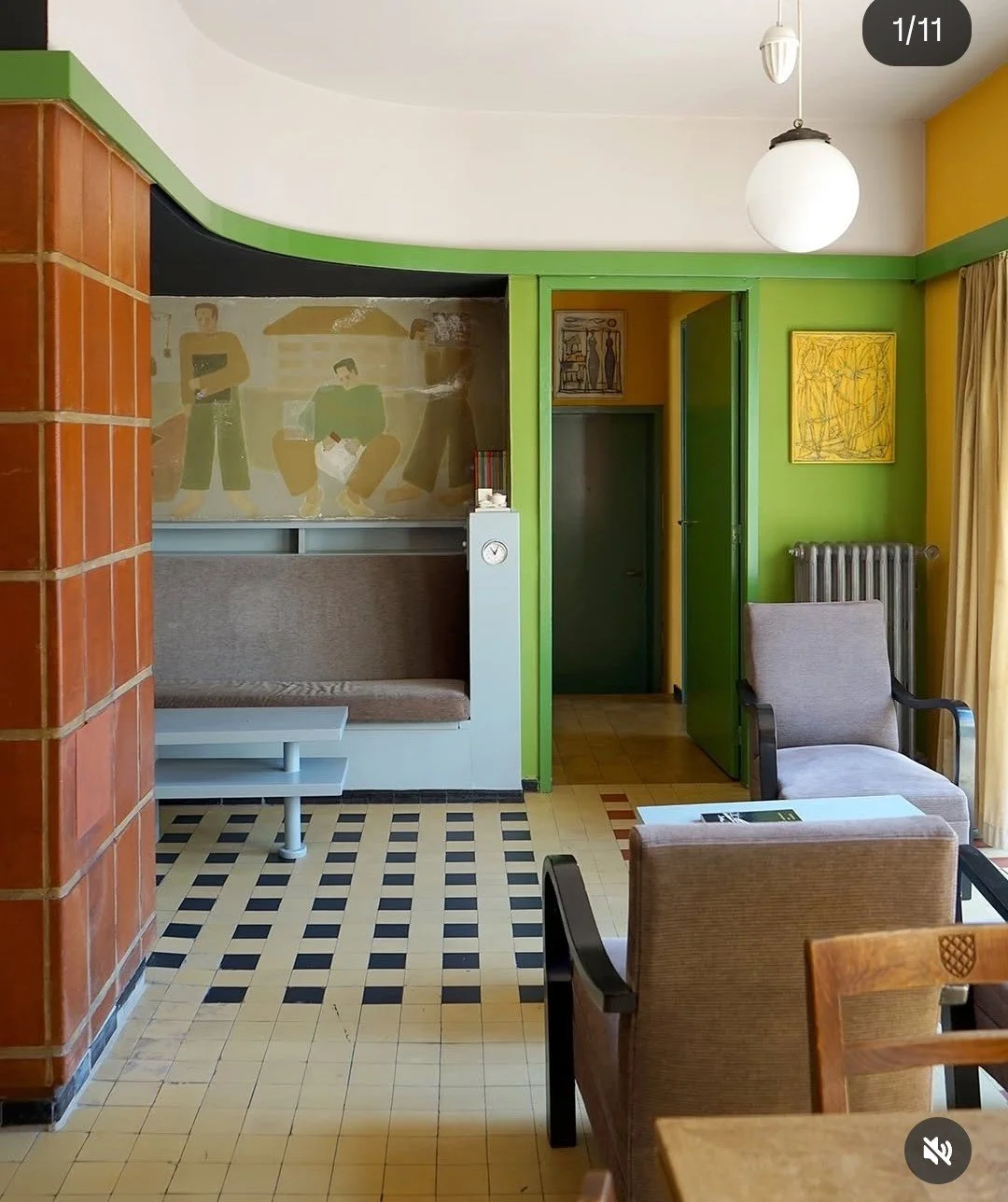
Jozef Schelleken House. Turnhout Belgium. Jozef Schelleken. c. 1935. Image courtesy of the photographer, Adam Štěch, and the Architectural Conservation Trust, Turnhout, Belgium.
A personal design philosophy is not something we establish once and preserve unchanged. Our beliefs develop as we acquire knowledge, encounter unfamiliar ideas, and test our assumptions through experience. A principle that seemed self-evident early in a career may become more nuanced after years of practice. A difficult project may reveal the limitations of an approach we once considered essential. A new encounter with art, architecture, or another culture may change how we understand a familiar problem.
This does not mean that our philosophy lacks conviction. It means that conviction and openness can coexist. Indeed, a philosophy that cannot accommodate new knowledge may eventually limit the very creativity it was intended to support. The objective is not to establish a permanent set of rules. It is to develop an increasingly conscious understanding of what we believe, why we believe it, and how those beliefs affect our work.
Jozef Schellekens's own home in Turnhout, Belgium (shown above) offers a compelling example. Designed in the mid-1930s, the house reflects his early commitment to Modernism and his interest in bringing architecture, furniture, and art together. Its geometric organization, integrated furnishings, vivid colors, and murals reveal an approach that embraced both functional design and artistic expression.
The result is a unique and distinctly personal interpretation of Modernism, shaped by the ideas and principles that informed his work at that time.
Over the following decades, however, Schellekens's beliefs about architecture changed, and those changes also found expression in his work. His career reminds us that a personal design philosophy can be both a source of creative individuality in the moment as well as something that continues to evolve.
Conclusion
We began this series by asking what it means for a designer to have a creative voice. We explored how that voice develops through observation, knowledge, experimentation, reflection, and the gradual recognition of our own creative tendencies. Now we can understand something more about what lies beneath it.
Our creative voice is the expression of our design philosophy—the beliefs, values, and principles that inform our way of thinking and making.
Those beliefs may begin as instinctive responses. Through reflection and experience, we can bring them into conscious awareness. And that awareness matters. When we understand what we believe, we can question our assumptions, strengthen our judgment, and make more deliberate choices.
But beyond that, we can bring something deeply personal into our work: the ideas and values that have meaning for us.
Discover your voice. Understand the beliefs that give rise to it. And use that understanding to make work that is not only more intentional, but more meaningful.
That is where the poetic meets the practical.
