
Abstraction: The First Language of Meaning
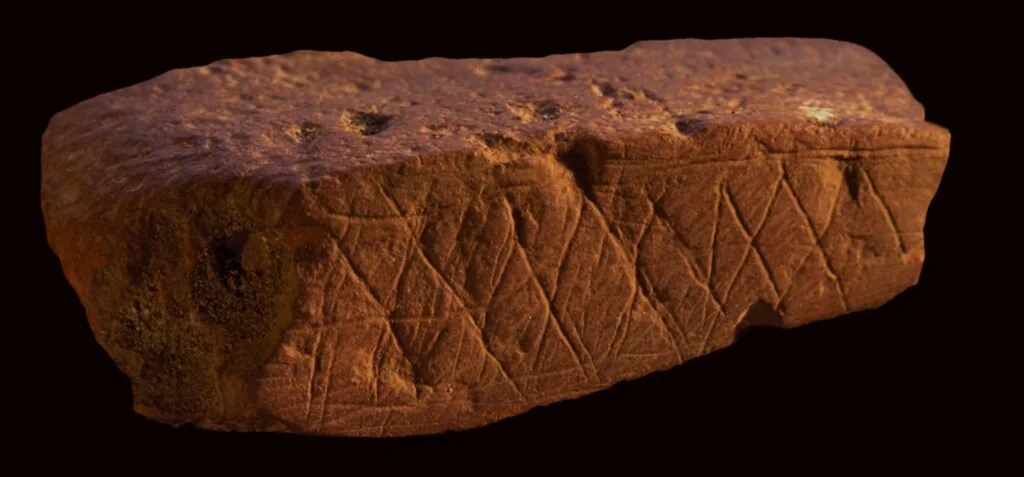
Incised ochre from Klaises River Cave 1. c.90,000 BCE. South Africa. Photo courtesy of Dr. Riaan Rifkin. https://www.sciencedirect.com/science/article/abs/pii/S0305440311003992
How did humans first create meaning through visual form? Abstraction.
Long before writing, humans were engraving repeated geometric patterns, reducing animals to barely recognizable forms, and creating symbols whose meanings we can only begin to imagine. The object above is among the oldest known examples. Carved into a three-inch piece of ochre, three inches in length, approximately 75,000 years ago, its intersecting lines raise a fascinating question:
Why these lines? We don't know.
Archaeologists continue to debate the precise meanings of many prehistoric abstract signs. But there is broad agreement that they were deliberate, and meaningful—not random decoration.
And this was not an isolated incident. Across thousands of years and a variety of materials, abstract patterns and forms appear again and again. Many of the same visual motifs are repeated, suggesting that these marks carried enduring significance.
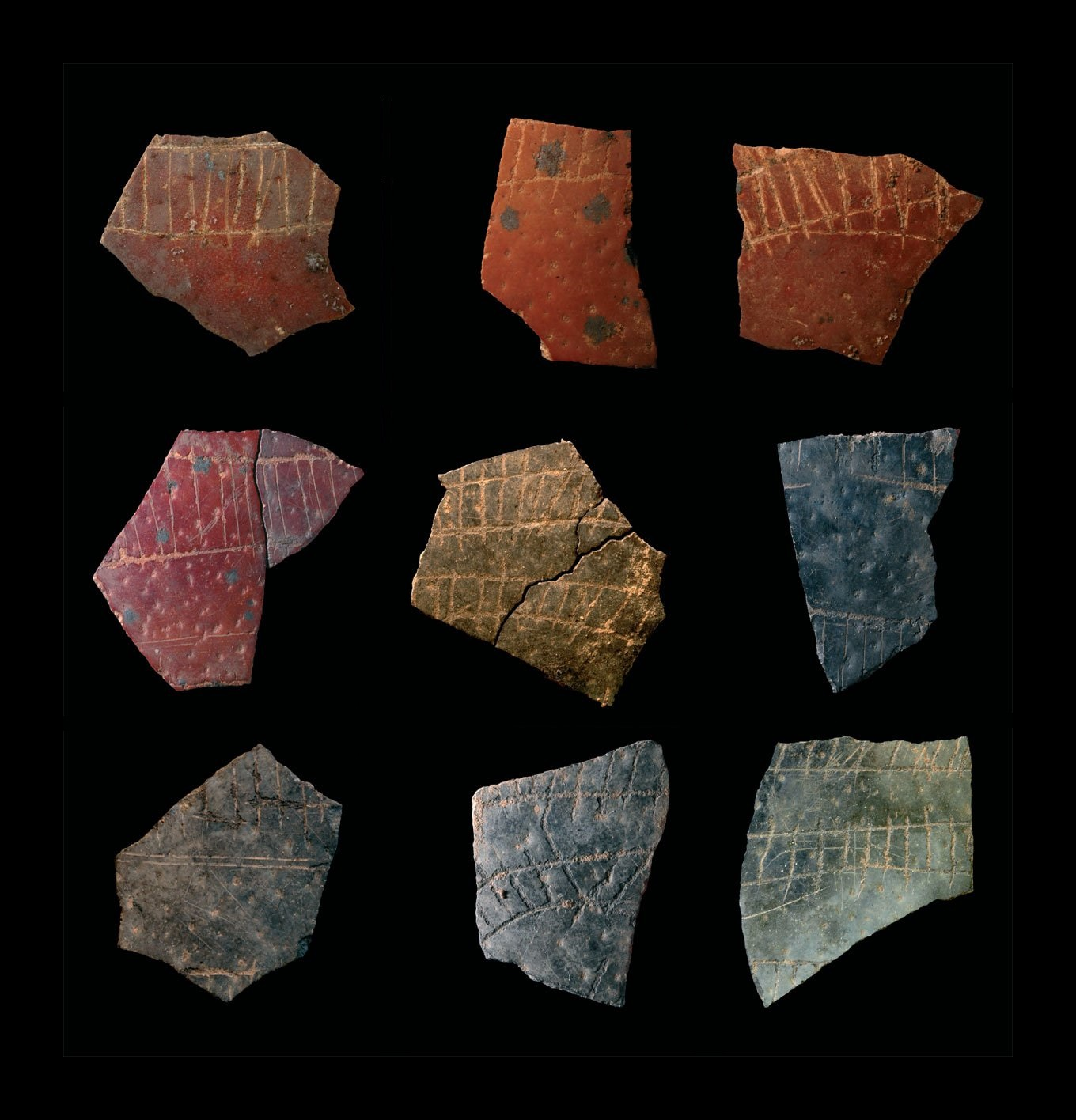
Diepkloof Ostrich Eggshell Engravings. South Africa. c. 60,000 BCE. CC BY SA 4.0. https://creativecommons.org/licenses/by-sa/4.0/ https://www.science.org/content/article/engraved-eggs-suggest-early-symbolism.
Thousands of years after the Klaises River ochre, a different linear pattern appears on ostrich eggshells, which were used to carry water. Here, the compositions have become more sophisticated, requiring greater planning and organization. Horizontal parallel lines, crossed by regularly spaced vertical lines—almost like railroad tracks—form a series of carefully ordered rectangular compartments.
Their meaning? One interpretation is that they functioned as a form of identification, allowing individuals or groups to recognize their own water flasks. We cannot know for sure. Their significance, however, is more certain. Throughout recorded history, people have often believed that objects could embody qualities they wished to possess—that wearing an amulet, carrying a talisman, or using a vessel marked with meaningful symbols could bring them into closer relationship with the power those markings represented: protection, fertility, healing, strength, or other desired attributes. As such, it became desirable to place these symbols on objects—even on walls—with which people came into repeated contact.
We cannot know whether the makers of these engraved ostrich eggshells shared those same beliefs. Yet it is tempting to wonder whether we are seeing the earliest surviving evidence of a profoundly human impulse: to give physical form to invisible ideas—and, by living with those objects, carrying them, touching them, or using them, to bring ourselves into closer relationship with the qualities they express.
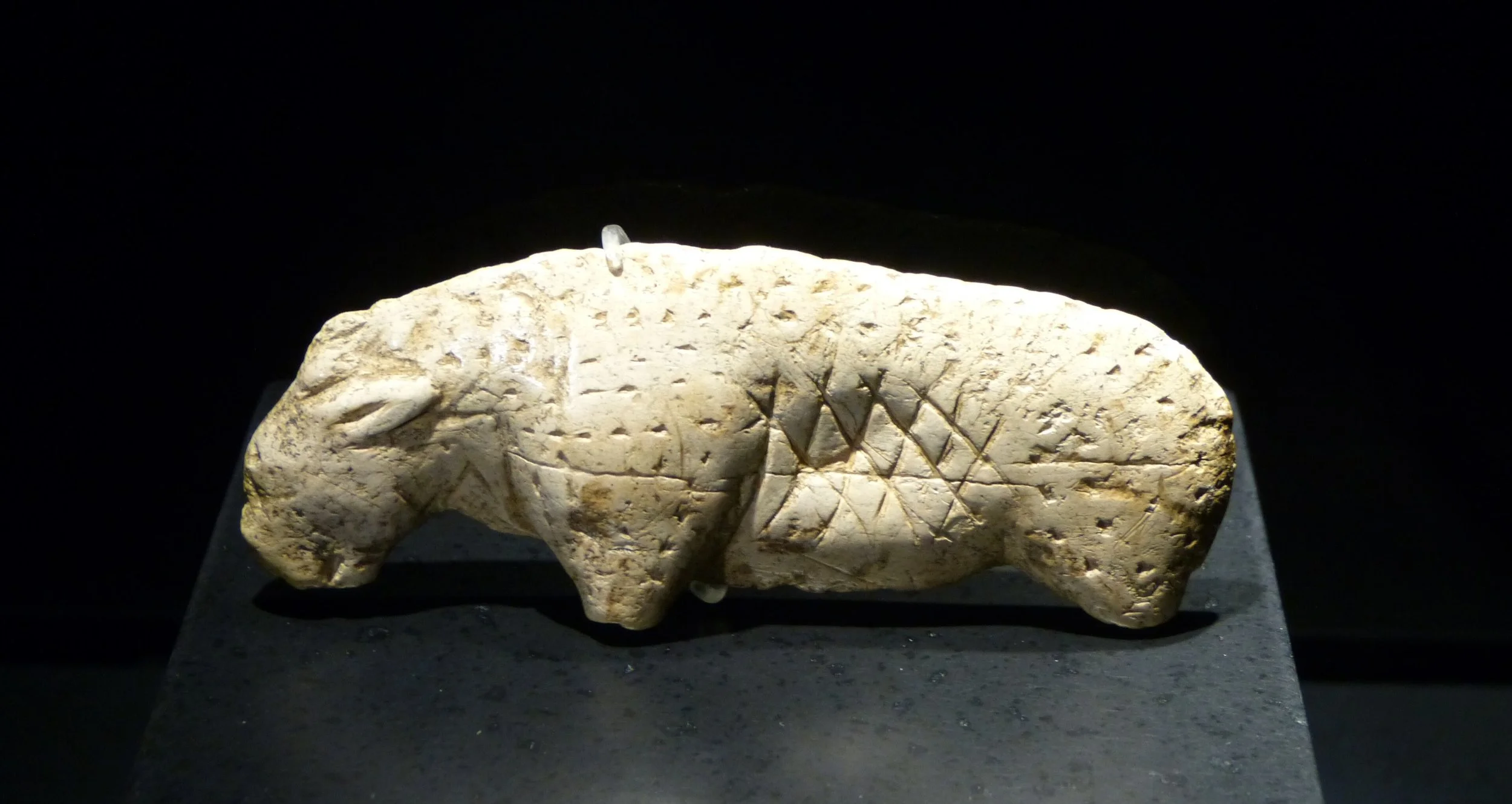
Lion. Mammoth ivory. Vogelherd Cave, Germany, c. 33,000 BCE. Museum of the University of Tübingen. c. 33,000 BCE. CC BY SA 3.0 https://creativecommons.org/licenses/by-sa/4.0/deed.en
But abstraction was not confined to two dimensions. It became an equally powerful way of communicating meaning through three-dimensional form. This tiny mammoth ivory figure, is identified as a lion, yet it bears little resemblance to the animal as we see it in nature. Anatomical details have largely disappeared, and the body has been simplified to its essential form.
Only about 2.3 inches long, it was likely intended to be carried—held in the hand or kept close rather than displayed. The familiar cross-hatching pattern, prominently placed and painstakingly carved into such a demanding material, together with its appearance on objects spanning thousands of years and different media, strongly suggests that these marks held special significance for the people who made them. The meaning of the small triangular impressions covering the body, however, remains unknown.
The animal itself offers another important insight. Rather than depicting a specific species, the maker created a more generalized, perhaps composite, creature, emphasizing qualities or ideas beyond those conveyed by any one animal. In doing so, abstraction shifts the emphasis from appearance to meaning, allowing visual forms to express ideas that literal representation cannot.
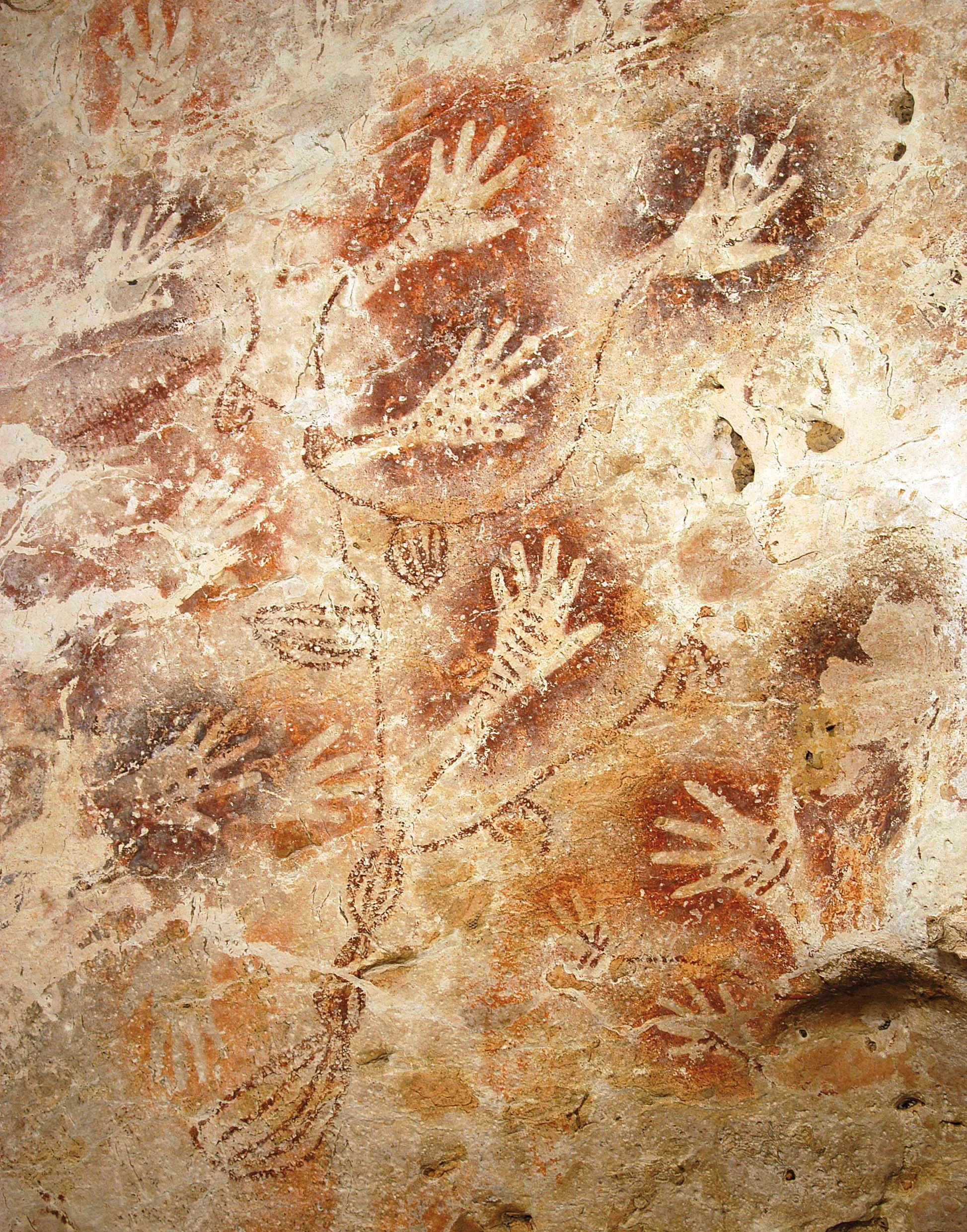
Hand Stencils in the "Tree of Life" Panel Cave Painting. Gua Tewet, Kalimantan, Indonesia. c. 8000 BCE. CC 1.0
Perhaps the most powerful example of prehistoric abstraction is also one of the simplest.
Hand stencils appear across vast stretches of time and geography, from Ice Age Europe to Southeast Asia. Their precise meanings remain debated, but their persistence suggests that this simple image held lasting significance.
These images contain almost no detail. The hand has been reduced to little more than its silhouette—yet we recognize it instantly. Here, abstraction takes another important step. Rather than creating geometric patterns, the maker reduced a three-dimensional object to a simplified two-dimensional graphic. The hand became a visual symbol rather than a literal representation. By reducing the hand to its essential form, the maker created an image that seems timeless. It could have been made yesterday. In doing so, abstraction reveals one of its greatest strengths: by stripping away the incidental, it preserves what is essential—and therefore what is most enduring.
By the time this Indonesian cave painting was created, abstraction and representation were no longer separate ways of seeing. The hand had become part of a larger visual composition, integrated with other visual forms to express meanings and relationships beyond any single image. Here we begin to see not simply individual symbols, but increasingly sophisticated visual narratives.
The hands may have marked identity, family, ritual participation, lineage, or simply the presence of those who stood before the cave wall. Whatever their purpose, they demonstrate that abstraction could communicate profoundly human ideas with remarkably little visual information.
Even today, these simple silhouettes possess an extraordinary power to move us—to bridge the distance between then and now, reminding us that, despite the passage of thousands of years, they were human too. They were here.
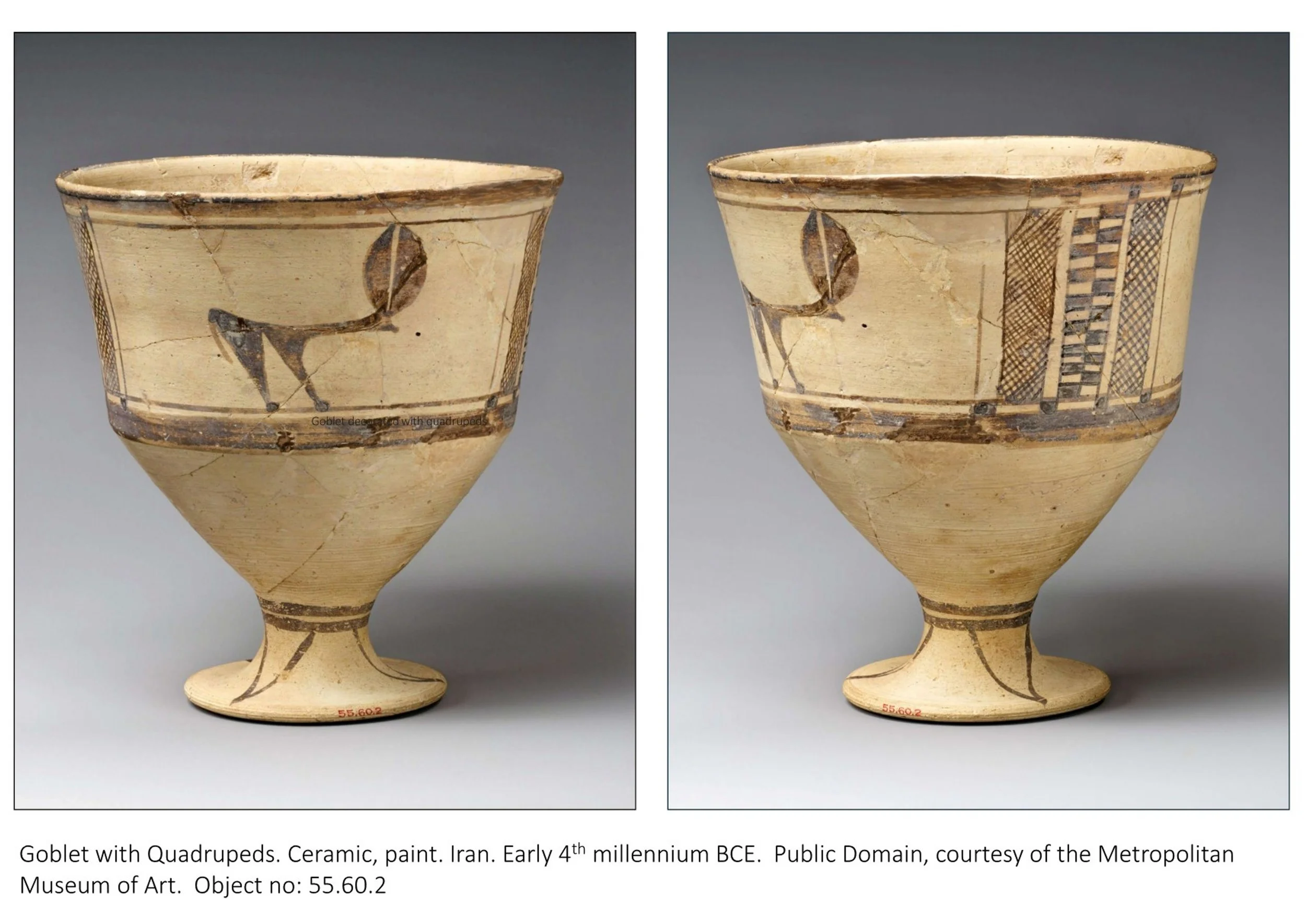
By the time this goblet was made, abstraction had become a sophisticated visual language. Cross-hatched motifs now appear almost like woven textiles, while the rectangular boxes seen on the eggshells have evolved into checkerboard patterns. Lines and bands divide the surface into orderly registers, evidence of increasingly sophisticated compositions.
Whether these ancient patterns still carried the meanings they once held, we cannot know. Yet people continued to surround themselves with them. Why? We can only speculate. Perhaps they had become traditional forms that connected people to their past. Or perhaps, even after their original meanings had changed or been forgotten, people simply continued to find comfort in familiar ornaments whose histories stretched far beyond living memory.
The animal offers another important insight. Like the hand stencils before it, it is no longer presented as a literal representation of a three-dimensional subject. Instead, the maker transformed it into a simplified two-dimensional graphic. Rather than depicting a specific species, the maker created a more generalized, perhaps composite, creature, emphasizing qualities or ideas beyond those conveyed by any one animal. In doing so, abstraction shifts the emphasis from appearance to meaning, allowing visual forms to express ideas that literal representation cannot.
From the first engraved lines on stone to the sophisticated visual language of a fourth- millennium goblet, abstraction became one of humanity's most powerful creative tools. By simplifying, organizing, and transforming the visible world, it allowed people to communicate ideas that could not always be expressed through literal representation alone. Thousands of years later, abstraction remains at the heart of art and design, continuing to help us move beyond appearance to express what is most essential.
Related reading: Before the Split: Prehistory and the Origins of Meaning
Related reading: Design Concept in Interior Design: Meaning, Method, and Creative Depth
Related reading: Connecting the Dots: Why Design History Matters to Practice
Be sure to sign up below to receive guidance, visual insights, ideas, and resources to help you develop a deeper way of seeing and understanding art and design. (Coming soon!)
